

Bettina
Rheims was originally a model but then turned to phtography in 1978.
Her works are famous of “erotic” or nude women images, which
always seen by her dramatic series of portraits of strip-tease
artists and acrobats. For example series titled Portraits(1981)
has featured striptease artists and acrobats posing in her studio.
Later on Rheims has collaborated with novelist
Serge Bramly for several projects like Chambre
Close
(1992), I.N.R.I.(1998)
and my favorite one Rose.
C'est Paris
(2009), which images were coupled with fictional text by Bramly.
In
1994, she was awarded the
Grand Prix de la Photographie of
the City of Paris. Also, she was awarded the Chevalier
de la Légion d’Honneur
for her lifetime’s achievement in 2002.

Photo from artnet.com/
This is from series called Gender Studies in 2012 and currently exhibited in Camera Works.
Objects in photos were the woman who wants to be man, man who see himself as woman etc,
about the subject of transsexual and transgender.
Rheims said she wanted to ask how people see "What is woman? What is man?"
Is our perception limited on our sight on body?
A very meaningful series.

from series Rose C'est Paris 2009

Olga Rodionova from The Book of Olga by Bettina Rheims, 2008
I
don't see Rheims's works as erotic or even think of the works as
“pornography” by the way she photographed the nude body. Her humanly approach with her artistic skill
of photographing portrays the power that can be electrified by female
body: challenges the men how they see woman and questions the women
how they see or even appreciate their body. I think that 's why
Rheims keeps doing the nude or exposed body of female in her works.
Maybe
Rheims is trying to state about the relationship between the body and
human: the empowerment from our body to our mind, our confidence, and
of course what is the meaning of showing nude to others; I am wondering maybe it is about the human nature of how human perceive the
meaning from nude body, as fantasy?as desire? As feminine? As sexual? Or?
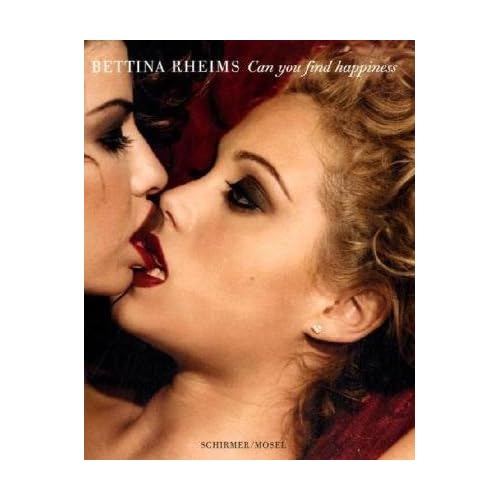
Can you find happiness? (2008)
In
one of the interview, Rheims said that "I wanted to play with
desires and fantasies, to work on seduction, what you show or what
you don´t show and how far you go. If you acts and appears today, it
may be because there isn´t anything more sure than voyeurism."
------------------
P.S.
The black and white in Rheims' work
In an interview from Art Limited, it mentioned about the reason why Rheims likes to use high-contrast black and white in her photographs: Neo-noir, the noir-ish.
It is a filming skill originally used in French film, which the director used to portray " a difficult situation and making choices out of desperation or nihilistic moral systems. Visual elements included low-key lighting, striking use of light and shadow, and unusual camera placement."
The black and white in Rheims' work
In an interview from Art Limited, it mentioned about the reason why Rheims likes to use high-contrast black and white in her photographs: Neo-noir, the noir-ish.
It is a filming skill originally used in French film, which the director used to portray " a difficult situation and making choices out of desperation or nihilistic moral systems. Visual elements included low-key lighting, striking use of light and shadow, and unusual camera placement."
For example, Rheims' s photographic book Rose C'est Paris 2009 was published an extra edition with a DVD, to provide another media to narrative the story of Rose's journey in finding her twin sister in Paris.
I think it is the reason why Rheims uses black and white in some of her works,
maybe because she wants to approach the meaning similar to the Neo-noir,
the confused, struggles, all the ups and downs story in the series,
and give the series a stronger emotion and mood.
But in my opinion, the most important is even Rheims seems to agree that,
black and white photos can give a deeper moody narrative than color photos,
whatever desperation or seduction.
I remember one of our readings Uses of Photography 1980, by John Berger,
pointed that photography encourages a story to be told, which it narratives itself. (1980:43)
If photo is about narrative a story,
then black-and-white is about narrative an emotional story,
especially about the human,
about us.
2. Art Net:
- 3. Berger, J. (1980) Uses of Photography.
About Looking. New York: Phantheon Books. pp.42-43
4. Camera Works:
4. Edwynn Houk Gallery:
5. Galerie Jérôme de Noirmont - Galeries d´art France Paris

No comments:
Post a Comment