Project statement

John Berger mentioned about Photography is the form to encourage a story to be told, and it narratives itself. (1980: 43) The series of Candid Street Photographs, which are taken in cities in the United Kingdom, is about revealing and evoking the intimacy and solitude that exists between the city and people. As a voyeur, the photographer hunts for the unique moments of love and interaction between humans that happen around us everyday. As she thinks it is easy for us to ignore and neglect such intimacy, as we always forget that love is always around us, in the cities.

4.12.12

The Cities Intimacy and Solitude


Here are my final selection for the project.
 
There are several hidden changes in the series if you look carefully.
 1. The relationship from friends, married, family to alone;
2. ages from young, middle to old; also
3. quantity from couple, to 3, to a family size and back to 1.
 
Intimacy and solitude between us are always related to the state of relationship, time and age.
This is the way how we experience, express and live with love in our life.
 
I think of a famous quote which claimed by Henry Louis Mencken (1920), American Journalist and Critic,
"You can't do anything about the length of your life,
but you can do something about its width and depth."
 
 
Times flies, but we can still love if we have the ability.
 
 
(Intimacy 1. to 4.
Solitude 5. to 6.)


1. The Crossing Friends
 
The lovely interaction between this pair of friends.
It is also the photo which inspires me idea and direction of this project.
 
Edinburgh, Oct 2012


 2. The Walking Couple
 
It shares the same position and pose of the couple as the first photo,
but it expresses a total different emotion from the first.
It is not as intimate as the relationship in first photo.
 
Bristol, Nov 2012


 3. The Crossing Old Couple
 
Love the intimacy that expresses by this old couple,
and how it contrasts with the lonely man beside.
 
Bristol, Nov 2012


4. The Waiting Family
 
A family shot which shows the old man totally minded his own business only,
but the old woman had to take care of the two grandchilds.
It is kind of interesting scene and
 funny contrast here about the idea of "intimacy" (as a family) and solitude (seperated responsibility)
 
Bristol, Nov 2012


5. The Crossing Strangers
 
As I mentioned before, it is an interesting scene here,
which the composition suggests that they seem know each other, and is "intimate" in their position.
But when you look closer of their facial expressions,
they are strangers to each other: the form of solitude.
 
Bristol, Nov 2012


6. The Waiting Old Man
 
I intentionally put this photo of the lonely old man at the end of series,
just want to question people about the relationship between time and human,
and also about the concept of "intimacy" and "solitude" to everyone of us.
 
London, Nov 2012


Reference:
 
  1. Mencken, H, L. (1920), Retrieved on 5 December 2012, from


29.11.12

Memory and fantasy: Victor Burgin


Victor Burgin is an English conceptual artist, writer and photographer.  He studied painting at the Royal College of Art from 1962 to 1965 and philosophy and fine art at Yale University from 1965 to 1967. From the late 1960s he adhered to Conceptual art using combinations of photographic images and printed texts to examine the relationship between apparent and implicit meaning. 

In his Lei Feng series (1973; London, Tate), for example, he drew on semiotic, psychoanalytic and feminist theory to decode structures of representation. A teacher and theoretician, he published numerous writings on art theory and criticism, with particular concern for Postmodernist aesthetics.


Most of Burgin's works were in black and white, quoted by Galerie Thomas Zander, it said it is about the prism of narrative, memory and fantasy, by Burgin's direct to the gaze of real world.


Victor Burgin, ‘[no title]’ 1991
no title, 1991
from tate.org.uk


Victor Burgin, ‘[no title]’ 1991
no title, 1991
from tate.org.uk


Victor Burgin, ‘[no title]’ 1991
no title, 1991
from tate.org.uk


Talking about the use of black and white by Victor Burgin,
which is the "narrative, memory and fantasy",
I wonder if the form reminds people more about their past 
as it is used to be the only form of photography before the invention of color photography.

 
While it is too easy for everyone to take a color photography, and even makes it a too ordinary form,
does black and white fascinate people more about this "historic form"?
To evoke more fantasy of our memory than color photography?
So that s why we think the black and white has a more solid and dramatic feeling than color one?

 
Maybe of this reason, I want to shoot my project in black and white more than in color,
to  portray the ignored love and interaction in the cities in a more emotional drawing way.
Just to remind and redefine everyone the intimacy in the "cold" cities,
love is all around us.


References:
1. Galerie Thomas Zander

2. Tate

Fantasy and desire: Bettina Rheims


Bettina Rheims was originally a model but then turned to phtography in 1978. Her works are famous of “erotic” or nude women images, which always seen by her dramatic series of portraits of strip-tease artists and acrobats. For example series titled Portraits(1981) has featured striptease artists and acrobats posing in her studio. Later on Rheims has collaborated with novelist Serge Bramly for several projects like Chambre Close (1992), I.N.R.I.(1998) and my favorite one Rose. C'est Paris (2009), which images were coupled with fictional text by Bramly.

In 1994, she was awarded the Grand Prix de la Photographie of the City of Paris. Also, she was awarded the Chevalier de la Légion d’Honneur for her lifetime’s achievement in 2002.


Bettina Rheims, Andrej P. III, Paris
Photo from artnet.com/

This is from series called Gender Studies in 2012 and currently exhibited in Camera Works.
Objects in photos were the woman who wants to be man, man who see himself as woman etc,
about the subject of transsexual and transgender.
Rheims said she wanted to ask how people see "What is woman? What is man?"
Is our perception limited on our sight on body?

A very meaningful series.


from series Rose C'est Paris 2009


Olga Rodionova from The Book of Olga by Bettina Rheims, 2008


I don't see Rheims's works as erotic or even think of the works as “pornography” by the way she photographed the nude body. Her humanly approach with her artistic skill of photographing portrays the power that can be electrified by female body: challenges the men how they see woman and questions the women how they see or even appreciate their body. I think that 's why Rheims keeps doing the nude or exposed body of female in her works.

Maybe Rheims is trying to state about the relationship between the body and human: the empowerment from our body to our mind, our confidence, and of course what is the meaning of showing nude to others; I am wondering maybe it is about the human nature of how human perceive the meaning from nude body, as fantasy?as desire? As feminine? As sexual? Or?
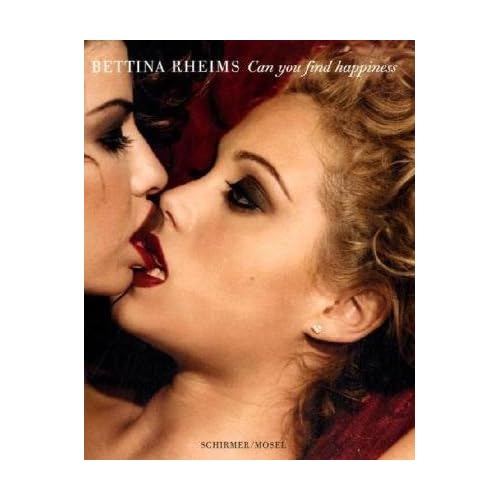
Can you find happiness? (2008)


In one of the interview, Rheims said that "I wanted to play with desires and fantasies, to work on seduction, what you show or what you don´t show and how far you go. If you acts and appears today, it may be because there isn´t anything more sure than voyeurism."


------------------

P.S. 
The black and white in Rheims' work

In an interview from Art Limited, it mentioned about the reason why Rheims likes to use high-contrast black and white in her photographs: Neo-noir, the noir-ish.

It is a filming skill originally used in French film, which the director used to portray " a difficult situation and making choices out of desperation or nihilistic moral systems. Visual elements included low-key lighting, striking use of light and shadow, and unusual camera placement."

For example, Rheims' s photographic book Rose C'est Paris 2009 was published an extra edition with a DVD, to provide another media to narrative the story of Rose's journey in finding her twin sister in Paris.

I think it is the reason why Rheims uses black and white in some of her works, 
maybe because she wants to approach the meaning similar to the Neo-noir,
the confused, struggles, all the ups and downs story in the series, 
and give the series a stronger emotion and mood.

But in my opinion, the most important is even Rheims seems to agree that,
black and white photos can give a deeper moody narrative than color photos,
whatever desperation or seduction.

I remember one of our readings Uses of Photography 1980, by John Berger,
pointed that photography encourages a story to be told, which it narratives itself. (1980:43)


If photo is about narrative a story,
then black-and-white is about narrative an emotional story,
especially about the human, 
about us.


References:

1. Art Limited
http://www.artlimited.net/news/en/53117

2. Art Net:


    3. Berger, J. (1980) Uses of Photography. About Looking. New York: Phantheon Books. pp.42-43
    4. Camera Works:

    4. Edwynn Houk Gallery:

    5. Galerie Jérôme de Noirmont - Galeries d´art France Paris

    27.11.12

    Second trial photos, Bristol


    I have been to Bristol for staying a night,
    Thank God that the second day was rainy,
    so i could try to shoot some photos to see if any of them can be included in my project.

    As I discovered that it was quite difficult to shoot Candid Photography
    when i tried to do my project in London;
    because if it was afternoon and in a tourist spot,
    there would be too many people around,
    and the photos would include some unwanted people
    who distracted the attention of object in a picture.

    So after the tutorial, i decided to shoot my project about people waiting to or crossing the street,
    as a consistent pattern as the one in Edinburgh,
    and it is easier to capture the special moment of people's interaction.


    The couple was actually chatting,
    then the husband discovered that i was shooting them,
    so he avoided the camera by turning to his wife.

    It was interesting that even if they were chatting and as a couple,
    they always kept a distance between each other that time.

    Maybe it is the way they got used to?


    As i mentioned before,
    the way of old couple act is totally different from young couple.
    Young couple likes to express their love and intimacy by touching.
    I guess it is the way they feel connected in a relationship?


    Personally i think it is the most interesting photo so far for the trials i have taken.
    The position of, or the distance between the man and woman in photo suggested they seem to know each other,
    but if i look closer, actually i realize that they don't know each other by the way they look and walk to total different direction.


    The rainy and wet weather seems make them freezing and unpleasant.


    This is such a lovely photo that I have captured the interaction between the old couple,
    while the wife was trying to help putting the hat on her husband.
    The old man alone besides them also made a interesting contrast here,
    the intimacy, and the solitude. 


    This is another sweet photo as well but about a young couple.
    Under the freezing weather and the loads thing they have shopped,
    the man still hugged his girlfriend to keep her warm.
    Um, a bit jealous.

    Similar to the previous photo, the man who walked alone beside them,
    made a contrast here.

    When we are alone and seeing the couple's interaction besides us,
    we always feel awkward and uncomfortable .
    I guess it is probably because the comparison that we have made inside our heart.


    Probably the girlfriends or family were looking at same direction while waiting to cross the road.
    A bit blurred as i forgot to adjust the focus mode from Manual to Auto.
    But still I think it is a nice photo and i captured successfully the moment of this close interaction. 


    The bike couple in bridge.
    As i guessed the man was leading the woman of a bike tour in Bristol.


    The child happily left with their parents after the visit of M Shed,
    museum about introducing Bristol history.

    They all knew i was taking a photo of them.
    The parents felt shy and tried to avoid by their umbrella,
    but the kids just kept laughing and chatting to their parents.


    I guess they are married couple?
    Had a lovely date in M Shed for weekend.
    The man seems quite satisfied with the day out with the woman.


    All photos were edited by heighten a bit of brightness,
    and adjusted to the highest level of contrast to highlight the object and shadows in photos,
    also to enhance the dramatic solid feeling of them.


    After shooting these trials, 
    I have initially picked some photos to included in my project,
    with a consistent pattern of ---

    1. people's interaction
    2. the reflected shadows from wet floor after rainy 
    3. crossing the road


    26.11.12

    Practice 4: Focal length x Asking a stranger's permission


    The lesson has taught us two things:
    One is to try shooing photos with different focal lengths but with same setting and object,
    Second is to try asking a stranger's permission to take a photo of them.


    I. Focal Length

    50mm focal length of camera is similar to human eye,
    because of the similarity of angel between two.

    The practice is to try three different focal lengths:
    the smallest, 50mm and largest,
    so to shoot the same photo under the same setting
    by moving our body further or nearer
    and to find the differences among 3 photos.

    The lens i used was 18mm-55mm,
    so these photos were taken in 18mm, 50mm and 55mm respectively.


    18mm:


    50mm:


    55mm:


    While looking at these photos carefully,
    especially at the change of background,
    I discovered that the smallest focal length of lens is using,
    the shallower of the depth of field,
    which means the more blur of the background.


    Also in the photo which taken in 18mm focal length,
    the object seems much nearer to us and the background is further from us.
    It is totally opposite to the photo which taken in 55mm;
    which the object seems further and the background is closer to us.


    II. Asking permission of stranger

    As a photographer, we can't always do the candid photography as the only type.
    Or if we do, the object (person) may feel uncomfortable and not be respected
    if we have not ask their permission first.
    So, the practice is to enhance our self-confidence and braveness,
    to ask random people if we can shoot some photos of them.


    Normally, if i approached with smile and polite manner,
    most of them would say yes.

    I think the strategy of choosing a stranger to take photo is
    not to choose people in a rush, at work or talking in phone,
    because if they are  having their own business to do,
    we better don't interrupt them.

    The more relaxed of the person,
    the more natural photo we can get.